Our Mission
To train professionals who fully meet the current expectations of the tourism industry, who are equipped with up-to-date professional knowledge and practical skills, and who have strong communication skills, are participatory, dynamic and respectful of social values. By training competent individuals who will make a difference in tourism and hospitality businesses, we aim to provide direct and sustainable support to the economic development of our country.
Our Vision
To be a respected, nationally preferred and pioneering education program in its field that makes the highest contribution to regional and national development in the tourism sector, adopts innovative approaches, ensures continuous university–industry cooperation and is strictly committed to universal and professional ethical rules.
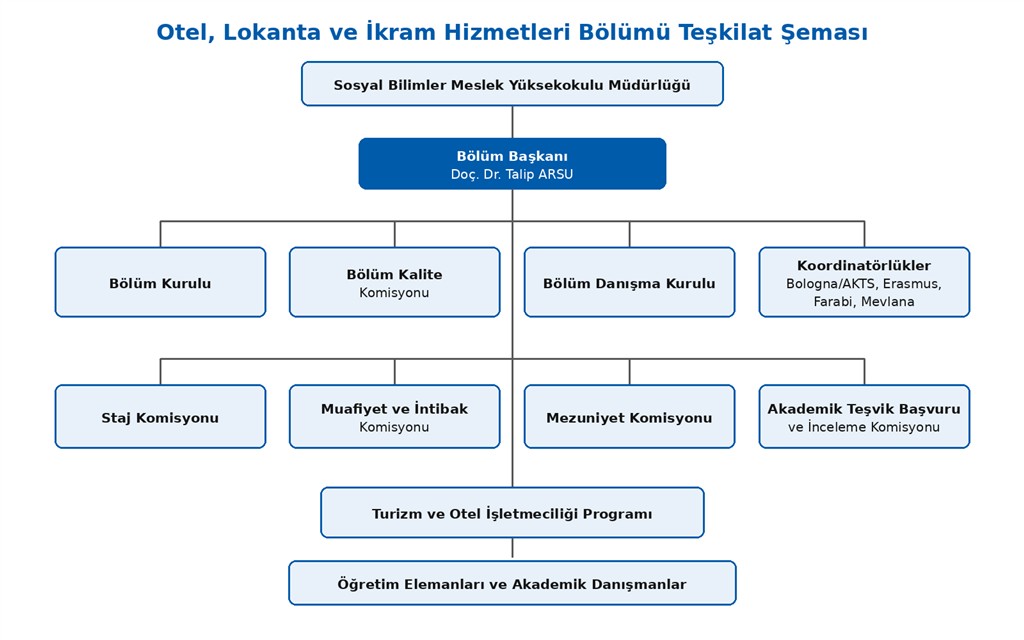
The duties, authorities and responsibilities of the administrators, academic staff and boards working in the Department of Hotel, Restaurant and Catering Services are defined in the job descriptions prepared within the Aksaray University Quality Management System. The job descriptions related to our department are listed below.
Job Descriptions
| Document No | Position |
| KYS-GT-118 | Head of Department |
| KYS-GT-119 | Faculty Member |
| KYS-GT-120 | Lecturer |
| KYS-GT-136 | Duties, Authorities and Responsibilities of Lecturers |
| KYS-GT-133 | Duties, Authorities and Responsibilities of the Advisory Board |
Department Board, Commissions and Coordinatorships
The distribution of duties of the Department Board, department commissions, coordinatorships and academic advisors is determined by a decision of the Department Board. For current assignments:
All job descriptions at the vocational school level are available here.
The education and quality processes in our department are carried out in accordance with the procedures published within the Aksaray University Quality Management System. The procedures directly related to our department are listed below.
Education and Training Procedures
Quality Management System Procedures
All procedures of our University are available here.
The education, research, social contribution and quality processes of our department are carried out in accordance with the processes defined within the Aksaray University Quality Management System. For the general structure of the processes, see KYS-OŞ-037 Aksaray University Process Chart.
Main Processes
Education and Training Processes
Sub-processes at Department Level
All processes of our University are available here.
The processes in our department are carried out in accordance with the workflow charts prepared for vocational schools within the Aksaray University Quality Management System.
Education and Training
Examinations
Student Affairs
Department Management
All workflow charts: kalite.aksaray.edu.tr/is-akislari
Our department uses the current form templates within the Aksaray University Quality Management System. For student petition and application forms, see the Student Forms page; for internship forms, see the Internship page.
Academic Staff Forms
Board, Commission and Quality Forms
All forms: kalite.aksaray.edu.tr/formlar
The management and decision-making processes of our department are carried out through the following boards, commissions and coordinatorships within the framework of Higher Education Law No. 2547 and related regulations. Assignments to commissions and coordinatorships are made by a decision of the Department Board.
Department Level
Vocational School Level
For the duties, authorities and responsibilities of boards, commissions and coordinatorships, see the Duties, Authorities and Responsibilities section.
|
Stakeholder |
Priority |
Form and Frequency of Interaction |
|
Our students |
Core partner |
Academic advising, advisor meetings (at least once per semester), student satisfaction and course evaluation surveys, student representation |
|
Academic staff |
Core partner |
Department board, commission and coordinatorship meetings (regularly during the semester) |
|
Administrative staff (Student Affairs, general correspondence) |
Core partner |
Process cooperation and correspondence (continuous) |
|
Vocational School Directorate and Executive Board |
Core partner |
Board decisions, official correspondence, quality meetings |
|
University senior management and relevant departments (Quality Coordination Office, Student Affairs, Personnel, Library, Health, Culture and Sports, BAP, Information Technologies, ASÜSEM, ASUZEM) |
Strategic partner |
Official correspondence, quality assurance processes, training and support services |
|
Stakeholder |
Priority |
Form and Frequency of Interaction |
|
Our graduates |
Core partner |
Department Advisory Board membership, graduate tracking survey, communication groups |
|
Tourism businesses where internships and cooperative education take place (hotels, restaurants, travel agencies) |
Core partner |
Internship acceptance and evaluation process, Business Internship Evaluation Form, workplace visits |
|
Professionals in the sector (hotel and restaurant managers, chefs, tour guides) |
Strategic partner |
Advisory Board membership, professional seminars and talks, sector opinions |
|
Professional organizations and associations of the tourism sector (TÜRSAB, hoteliers and tourism associations) |
Strategic partner |
Cooperation and joint events, sharing views on sectoral developments |
|
Employers and employer representatives |
Strategic partner |
Employer satisfaction survey, consultation in updating program outcomes |
|
Aksaray Provincial Directorate of Culture and Tourism and local governments |
Strategic partner |
Destination promotion, cultural heritage and alternative tourism activities, provision of internship places |
|
Aksaray Chamber of Commerce and Industry, Commodity Exchange |
Strategic partner |
Cooperation protocols, provision of internship places, sector opinions |
|
Parents of students |
Customer |
Advising meetings, information and announcements |
|
Vocational high schools (Accommodation and Travel Services, Food and Beverage Services fields) |
Customer |
Promotion and guidance activities |
|
YÖK, YÖKAK, ÖSYM |
Strategic partner |
Legislation, accreditation and quality assurance processes |
|
Tourism and hotel management programs of other higher education institutions |
Strategic partner |
Program comparison, sharing good practices, Farabi mobility |
The views received are evaluated in the Department Quality Commission; those requiring improvement are brought to the Department Board, and the results are shared with stakeholders.
The Aksaray University legislation applied in the education and quality processes of our department is listed below. The current versions of the texts are published on the Public Information Management System (KAYSİS).
Regulation
Education and Training Directives
Procedures and Principles
Quality and Internationalization
All legislation of our University: KAYSİS – Aksaray University
Public service standards are determined at the unit level by the Social Sciences Vocational School within the scope of the Regulation on the Procedures and Principles to be Followed in the Provision of Public Services. The documents required for application and the completion times of the services offered to our students (student certificate, transcript, horizontal/vertical transfer, course registration, exemption and adaptation, graduation, single course and excuse exams, objections to exam results, registration freeze, advisor assignment, course and exam schedules, make-up classes, etc.) are included in the Public Service Standards Table of our Vocational School.
Social Sciences Vocational School Public Service Standards Table
The identification of sensitive duties and the management of the risks related to these duties are carried out at the unit level by the Social Sciences Vocational School within the framework of the Aksaray University Sensitive Duties Procedure.
The public service inventory is prepared at the unit level by the Social Sciences Vocational School within the scope of the Regulation on the Procedures and Principles to be Followed in the Provision of Public Services. The inventory includes the delivery processes of services concerning our students, such as course registration, examination procedures, transcripts, internship applications, graduation and academic status procedures.
As the Department of Hotel, Restaurant and Catering Services of Aksaray University Social Sciences Vocational School, our quality policy is to train qualified intermediate staff who are equipped with professional knowledge and skills, guest-oriented, committed to ethical values and aware of sustainability, in line with the needs of the tourism and hospitality sector and in harmony with the quality assurance system and strategic goals of our University; to continuously improve our education, research and development and social contribution processes with the views of our stakeholders; and to manage these processes with a transparent, participatory and measurable management approach. In line with this policy, our department commits to the following.
Education and Training
Research and Development
Social Contribution
Management System and Quality Assurance
This policy is reviewed by the Department Quality Commission at the beginning of each academic year and updated by a decision of the Department Board when necessary. Last review: Department Quality Commission meeting dated 19.10.2026 (2026/1). The policy was accepted as valid for the 2026-2027 Academic Year without any changes and approved by Department Board decision no. 2026/6.
The 2026-2027 academic year work calendar of our department has been prepared on the basis of the Aksaray University Academic Calendar, the Unit Quality Policy and the 2026-2027 Department Quality Action Plan.
| Period | Activity | Responsible |
| September 2026 | Course assignments; appointment of commissions and coordinatorships; orientation; assignment of academic advisors | Department Board |
| October 2026 | Discussion of the course evaluation survey PDCA report; Bologna information package updates; determination of exam weightings; Quality Commission meeting; preparation of the Unit Self-Evaluation Report; advisor meetings; exemption and adaptation decisions | Head of Department, Department Board, Quality Commission |
| October–November 2026 | Fall midterm exams (31.10–08.11); evaluation of summer internships; updating of course information packages; in-program improvement meeting; meeting with the student representative; fall meeting of the Department Advisory Board | Academic Staff, Internship Commission, Quality Commission |
| December 2026–January 2027 | Fall final (28.12–08.01) and make-up (15–20.01) exams; course evaluation surveys; spring course assignments; matching of students with businesses for the Cooperative Education Program | Department Board, Academic Staff, Cooperative Education Coordinator |
| January–February 2027 | Graduation decisions; single-course and additional exams; spring exemption, adaptation and horizontal transfer procedures; mid-year evaluation of fall survey results and the quality action plan | Graduation Commission, Quality Commission |
| March 2027 | Spring midterm exams (20–28.03); internship information meeting; Erasmus, Farabi and Mevlana information meeting; proposals for updating the curriculum | Department Board, Internship Commission, Mobility Coordinators |
| April 2027 | Spring meeting of the Department Advisory Board; graduate and employer surveys; sector meetings and seminars | Head of Department, Quality Commission, Academic Staff |
| May–June 2027 | Spring final (25.05–04.06), make-up (11–16.06) and single-course exams; graduation decisions; year-end quality evaluation and report on the implementation of the quality action plan | Department Board, Quality Commission |